
Most healthcare organizations build their clinical schedules the same way they did a decade ago: fill shifts to a census target, follow historical averages, and trust charge nurses to make real-time corrections when the plan doesn’t match reality. The acuity data that would change those decisions, such as care complexity, nursing workload, and admission velocity, already exists in the EHR. But it almost never reaches the scheduling system.
That disconnect is expensive. Every real-time correction carries a cost that a better starting schedule could have avoided. Downstream, those same corrections create the premium-pay errors, blended-rate miscalculations, and compliance exposure we detailed in our recent piece on scheduling and payroll integration gaps.
Acuity-based scheduling fixes the starting point by aligning the number, skill mix, and credentials of staff on a unit to the actual needs of the patients on that unit. But it only works when the EHR, workforce management (WFM) platform, HR, payroll, and finance are working from the same data. That’s where most organizations stall.
This blog, part of our broader series on HCM modernization in healthcare, covers what EHR-to-WFM integration requires, where it breaks, where the reporting that proves its value should live, and sustain it.
Why Most Healthcare Schedules Are Built on the Wrong Data
Census-based staffing treats every patient as an interchangeable unit of demand. Take a 30-bed surgical unit at 28 patients on Monday and 28 patients on Thursday. On Monday, most are stable and awaiting discharge. On Thursday, a third are fresh post-ops; two are on insulin drips, and one is a rapid-response transfer. The census is identical, so the schedule is identical — even though the patients on Thursday require far more nursing care.
The data that separates those two shifts is generated every hour inside the EHR, but the scheduling system never sees it. Platforms like UKG, Workday, and Infor were built to manage labor as an operational resource. EHRs like Epic and Oracle Health were built to manage clinical care. They were never designed to share staffing logic.
So, charge nurses fill the gap manually. They scan the unit, assess acuity, and adjust staffing on the fly. Patients get covered, but every manual correction is a workaround for a schedule that should have been right from the start. Those workarounds carry downstream costs: unplanned overtime, premium-pay triggers, unbalanced workloads, and a scheduling record that doesn’t match what actually happened on the floor.
How Acuity-Based Staffing Addresses Actual Patient Need
Acuity-based staffing replaces the question “how many beds are full?” with “what care do these patients require, and who is available to deliver it?” It answers two related but distinct questions:
- Staffing level: How many nurses and support staff, with what skill mix, the unit needs during any given shift.
- Patient assignment: Which nurse takes which patients, so workload and required competencies are matched person by person.
These are often handled by different tools and different people, and both have to work properly for the model to pay off.
The inputs come from the EHR. Patient classification tools in Epic and Oracle Health produce acuity scores and nursing workload indicators. Active care protocols, procedure schedules, and admission, discharge, and transfer (ADT) activity show how much work a unit is absorbing. On the workforce side, hours per patient day (HPPD) is the productivity target finance and nursing agree to in the budget. Acuity-based models translate the clinical signal into hours, skill mix, and assignments, then measure them against that target.
Acuity models have been discussed in nursing literature for years. What’s changed is technology. To operationalize them at scale:
- UKG’s Clinical Scheduling Extensions quantify workload intensity and automate patient-to-staff assignments based on acuity data.
- Epic’s Teamwork module brings staffing coordination directly into the EHR, so clinical leaders can act on acuity where it’s documented.
The tools exist. The gap lies in connecting them to each other and to the HR, payroll, and finance systems around them.
The Cost of Acuity-Blind Scheduling
When the EHR and the scheduling platform operate as separate islands, the consequences show up on the unit, in the budget, and in the workforce.
The stakes are large. Labor makes up 56% of total hospital costs, according to the American Hospital Association. The 2026 NSI National Health Care Retention & RN Staffing Report puts the average cost of losing one bedside RN at $60,090. Each one-point change in RN turnover costs or saves the average hospital about $295,000 a year. Contract labor is just as costly: a travel RN averages $91.23/hour, compared with $59.46/hour for a staff RN including benefits. That gap is about $66,000/year for every travel nurse a hospital carries.
Overstaffing you can’t see
Without acuity data, scheduling teams default to conservative templates. The census looks full, so staffing feels justified, even on shifts when patients need less care. The surplus rarely gets labeled as overstaffing. It shows up as hours above the HPPD target, low productivity scores, and staff who could have been floated to a unit that needed them.
Understaffing where it matters most
High-acuity shifts get the same headcount as routine ones. Charge nurses catch the gap in real time, but by then the options are expensive: call-ins at premium pay; agency fills at a higher hourly rate, or incentive shifts that strain the labor budget.
Credential mismatches
Acuity-based assignments depend on knowing who is qualified to care for which patients. Licenses and certifications, such as CCRN, ACLS, and PALS typically live in HR, credentialing, or learning systems, not in the EHR. When that data doesn’t reach the point of assignment, a high-acuity patient can be assigned to a nurse without the required competency. That becomes a patient safety issue first and a rework problem second.
Burnout from inequitable workloads
Without objective workload distribution, some nurses consistently draw the heaviest assignments. That imbalance drives turnover; turnover deepens agency dependency, and agency dependency drives cost. The cycle begins with the schedule every time.
Schedule changes that don’t travel well
Every manual adjustment creates a data point that must move intact from the schedule to the timecard to payroll. When it doesn’t, the result is premium-pay leakage and overtime miscalculation. In a disconnected landscape, the schedule says one thing, and payroll pays another, but both are technically correct based on the data each one has.
Your EHR Already Knows What Your Schedule Doesn’t
The EHR is the richest real-time data source in healthcare. It captures patient severity, procedure schedules, and active care plans. That data already drives clinical decisions, so it should drive workforce decisions too.
When several high-complexity admissions push a unit’s acuity up in a few hours, that signal should reach the staffing office before the charge nurse has to raise it. When a wave of discharges drops a unit’s workload mid-shift, the system should flag the chance to redeploy staff rather than carry the surplus to shift change. The data for both decisions exists already; it just doesn’t travel.
It also has to travel both ways. Acuity and demand flow from the EHR to the WFM platform, but staffing decisions need to flow back. The nurses actually working on the unit should update the EHR’s care team records, nurse call systems, and secure messaging. Otherwise, clinical workflows route alerts and orders to the wrong person.
EHR vendors are recognizing this. Epic’s Teamwork module, for example, brings staffing coordination into the clinical environment and moves the EHR beyond documentation toward an operational hub. But for most health systems, the EHR is still one system in a larger stack of HCM, WFM, timekeeping, and payroll platforms. Native EHR staffing features don’t eliminate the need for integration across that stack, they simply change its shape.
Where the EHR-to-WFM Integration Breaks
The interface itself is rarely the hardest part. HL7 ADT feeds, FHIR APIs, and vendor connectors move the data. Programs stall on the decisions and data that sit around the interface.
The systems don’t agree on who, where, and what
The EHR knows a unit as a department. Finance and payroll know it as a cost center. The WFM platform has its own organizational hierarchy. The same nurse has an EHR user ID and a separate HR employee ID, and job codes, skills, and shift definitions rarely line up across systems.
Until those mappings are built and governed correctly, acuity data can’t land on the right unit or the right person. This is the most common reason acuity integration stalls, and the least visible one at kickoff.
Acuity scores have to be trustworthy
A patient classification tool is only as good as the documentation behind it. Nurses on the same unit may score the same patient differently. Acuity is often scored once per shift and can lag what’s happening on the floor. And scores can drift up or down to justify a staffing level. Leading organizations give nursing informatics ownership of the tool, validate it on a regular schedule, and audit how consistently different nurses score the same patients.
Regulation sets the floor
Acuity-based staffing works within regulatory requirements, not around them. Depending on the state, hospitals may face mandated nurse-to-patient ratios, required staffing committees, or formal staffing plans that must be published and reviewed.
Federal and accreditation standards also expect evidence that staffing matches patient needs. These requirements vary widely and continue to evolve, so the staffing model must be configurable enough to absorb new rules without a redesign.
Wherever ratios apply, they set the minimum. Acuity determines what’s needed above it, and the staffing plan must document how.
Labor rules constrain every recommendation
Collective bargaining agreements and labor policy govern seniority, float order, call-off order, holiday rotation, and overtime. Many states restrict mandatory overtime for nurses. If the WFM platform doesn’t encode these rules, its acuity-driven recommendations will be overridden, and clinical leaders will stop trusting them.
Finance and nursing must share one definition of workload
Staffing grids and HPPD targets come from the budget process and from position control in the HR system. If the acuity model defines workload one way and finance productivity reporting defines it another, the two sides will argue indefinitely about which number is right. Bring finance in at the design stage, not after go-live.
Contingent labor and float pools sit outside the loop
Agency and travel fills run through vendor management systems, and internal float pools depend on cross-training and competency data. Both have to be a part of the integration. Otherwise, the most expensive fills stay invisible to the model meant to reduce them.
Where the Numbers Come Together
The metrics that prove acuity-based staffing works don’t live in the EHR or the WFM platform alone. Acuity-adjusted labor cost, predicted versus actual acuity, and premium-pay leakage by unit all require data from at least four systems: clinical acuity from the EHR, scheduled and actual hours from the WFM, cost from payroll, and targets from the budget. Bringing them together takes a dedicated enterprise layer:
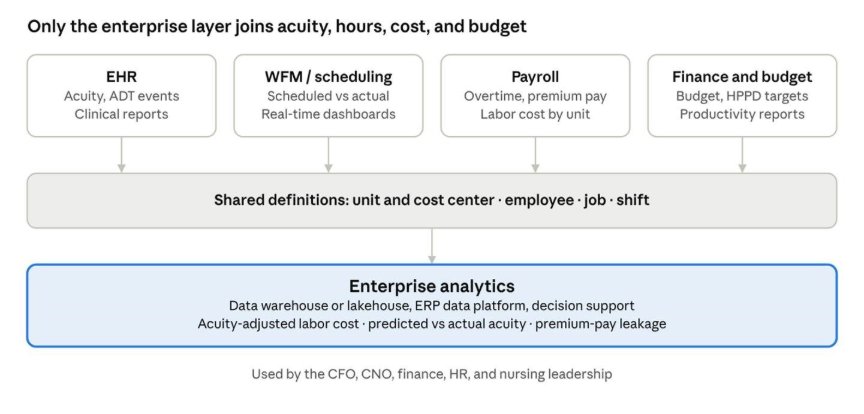
Operational dashboards and clinical reports stay in their source systems, where nurses and analysts use them day to day. The cross-system measures executives need typically come only from the enterprise layer.
That layer only works if the systems agree on these shared definitions: unit and cost center, employee, job, and shift. Without that foundation, every report becomes a reconciliation exercise, and nursing and finance each defend their own version of the truth.
This layer also needs a clear owner. Someone must decide which system is the source of truth for each metric, who maintains the mappings, and who signs off when definitions change. Organizations that treat acuity reporting as a data governance program rather than a dashboard project are the ones whose numbers get trusted.
Managing Predictive Staffing After Integration
Once acuity data is flowing into the schedule, the next step is using it to forecast demand instead of reacting to it.
Plan across time horizons
Acuity data serves each planning horizon differently:
- Long-range (annual budget and position control): Set HPPD targets and position counts using acuity trends, not just census history.
- Mid-range (the 4–6-week schedule): Build templates that reflect which units see complexity spikes on which days, and where seasonal patterns outpace the standard grid.
- Short-range (24-72 hours out): Adjust using procedure calendars, planned admissions, and expected discharges from the EHR.
- Real-time (within the shift): Redeploy staff from a central staffing office that sees acuity across units, not one unit at a time.
Layer in scheduled demand signals
Procedure calendars, planned admissions, and known discharge timelines all live in the EHR. Feeding them into the scheduling engine means next week’s plan reflects what’s coming, not just what happened last quarter.
Capture every override
When a charge nurse overrides a staffing recommendation, record it with a reason. Overrides are the richest calibration data you have, and acting on them is how the model earns clinical trust.
Build a consistent feedback loop
Predictive models only improve if they’re measured. Compare predicted to actual acuity by unit and shift and use the variance to recalibrate. Organizations that treat this as a one-time implementation will see accuracy degrade over time. Those that build review cycles into their workforce management process will see it compound.
Measure outcomes, not just labor cost
Tie acuity-adjusted staffing to nurse-sensitive outcomes such as falls, pressure injuries, and central line infections, along with nurse turnover and agency spend. That’s the evidence that earns sustained sponsorship from the CNO and the CFO alike.
Keep clinical leadership in the loop
Predictive staffing doesn’t replace clinical judgement; it gives clinical leaders better information to work from. Charge nurses and managers should see forecasted acuity alongside the schedule. The goal is to move decisions earlier, not to automate them away from the people closest to patient care.
Closing the Gap
The EHR already holds the signal that should shape every schedule. The scheduling, HR, payroll, and finance systems already hold everything needed to act on it and measure the result. What’s missing is the connective layer: shared definitions, governed data, bidirectional integration, and reporting that both nursing and finance trust.
Organizations that close the gap move from correcting the schedule shift by shift to getting it right at the start. That means less premium pay, fewer agency fills, more equitable workloads, and a staffing record that matches what actually happened on the floor.
Surety Systems helps health systems design and deliver the connective layer, from EHR-to-WFM integration and master data alignment to the reporting and governance that prove its value.